
In September we spent two weeks with Chinese companies: first on an investor technology tour through Suzhou, Hangzhou and Shenzhen, then at the annual CITIC CLSA forum in Hong Kong. We met more than 20 Chinese companies in person, a selection that leaned towards technology but also took in autos, consumer, property services, telecoms, pharmacy and healthcare.
 We arrived three weeks after Ursula von der Leyen had put a number on Europe’s frustration: an EU trade deficit with China of close to €1bn a day, with every member state now in deficit. That figure is just as much China’s problem as Europe’s. A surplus that size reflects an economy making more than it can profitably sell at home, what Beijing now calls ‘involution’.
In the same week as the speech, four Chinese ministries quietly launched a campaign to drive up quality standards in autos manufacture, echoing a similar push in two-wheelers a few years prior. Six weeks later, Beijing accepted a cap on hybrid exports to Europe of 350,000 next year, roughly 2025’s level, deflecting the risk (for now) of tougher tariffs. Days later, the Ministry of Finance confirmed that the export VAT rebate on new-energy vehicles will fall from 13% to 9% from April 2027, a cost analysts expect to be passed on through higher prices. A stance that prioritises profits over volumes is entirely a new one for China, begging the question we carried into each meeting: if volume turns from asset to liability, where will growth actually deliver returns?
Over the course of the week investor interest was high, but discriminating. Fuyao Glass – a specialist in auto glass, lately gaining market share while growing margins – proved one of the best-attended meetings of the forum; Zhongji Innolight, likewise. Investors on the technology tour broadly agreed that Montage had been among the most positive interactions. All three are held across Gemway equity funds.
Market focus: the broom comes out
Many expect part of Europe’s answer to its trade balance with China to be negotiation of a stronger renminbi, and a comparison is often drawn with Japan before the 1985 Plaza Accord. Japan too was a mercantilist power with excess capacity and a large trade surplus. Beijing insists market forces set its currency, but few outside Beijing agree. Brad Setser of the Council on Foreign Relations points to the daily fixing and state-bank intervention as evidence of tight management. Chancellor Merz and President Macron appear to agree on this, and have urged Brussels to press for appreciation. And China’s exporters, converting far more of their foreign earnings than usual, appear to be betting on a stronger renminbi.
But the currency is only half the story. As Michael Pettis argued in a Carnegie essay published the week we were in Hong Kong, the Plaza Accord did not cause Japan’s lost decades; Tokyo’s response did. It met the strong-yen slowdown with very cheap credit, which flowed into property and still more capacity. The test for China, then, is less whether the renminbi rises than what Beijing does with the excess. On that, the signals are more encouraging than many assume.
While the policy signal from auto industry negotiations is both important and material in its own right, it is also a reminder to look at China signals ‘in the round’. Sector-by-sector quotas are a buffer, not a cure: as Setser notes, what is occurring with autos exports to Europe would need extending to ever more sectors to stand in for reform at home or a stronger currency.
However, 'anti-involution' can be driven by other means: quality enforcement rather than price controls. Banks and real estate know this all too well. Fitch counts a record 670 bank closures in the latest annual tally, mostly small rural lenders absorbed by larger ones, leaving 3,139 banks after a 23% fall in four years. Vanke, long treated as the developer the state would not let fail, found its state-owned shareholder capping support. This is where the Japan comparison is most useful, and most reassuring. Tokyo's mistake after 1985 was to reflate through the banks, postponing the adjustment until it became a financial crisis.
What we see in China today points the other way: weak lenders are being closed rather than recapitalised, real estate developer leniency is reducing, and policy is disincentivising capacity rather than funding more of it. So far the clean-up is on the supply side; it is not yet a shift of income towards households, which is what would allow consumption to absorb more of what China produces. In fact, to fill the hole left by real estate’s decline, tax enforcement has stepped up on individuals, formalised in a July announcement and now reaching well beyond the ultra-wealthy. For most China investors, pro-consumption measures feel so long overdue that many have given up hope of the promised rebalance. But, if there is one constant on the mainland beyond death and taxes, it is the GDP growth target. And if the export engine slows (or is allowed to slow), investors can be confident that another engine will eventually be fired to pick up the slack.
AI in China: profit pools for the adventurous
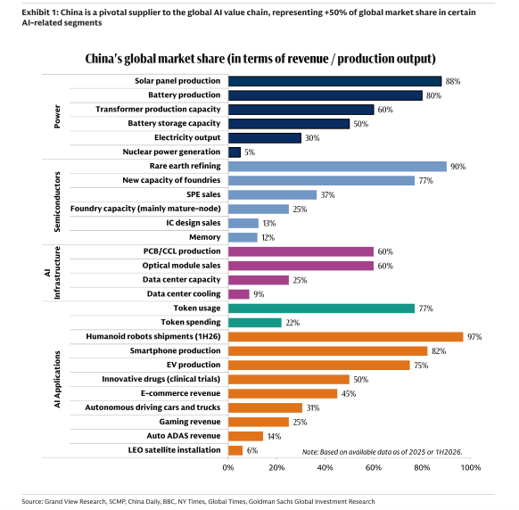
 Chinese names feature increasingly all along the global AI value chain. CXMT and YMTC are gaining ground in global memory, Chinese frontier lab AI models feature among the world’s best, and domestic computing chip supply is improving at a rapid pace. China is gaining share, and few doubt it will continue to do so. Share is not the same as profit, however; on Goldman Sachs’s estimates, China’s listed AI universe earns half the return on equity achieved by US and European peers.
As ever, our search in China was for these players with leading market positions, able to turn share into attractive returns. For example, optical transceiver-maker, Zhongji Innolight whose management gave a confident account: leadership in the most advanced products is still uncontested, Nvidia remains a key client, and near-packaged optics (NPO) for Amazon’s AWS from the second half of 2027 will drive revenues higher still. Yet the future is complicated: US lawmakers want Innolight products excluded from government data centers. The volumes here are small, but the political signal is meaningful.
Upstream from the chipmakers, we met Grace Fabric, which makes the specialty glass cloth that goes into AI chip substrates and boards. The business is a valuable read-across to GemChina holding, China Jushi. More specialty cloth come with greater profits, and gross margin has risen from 35% to around 60% year to date, with 65%+ possible next year. It has doubled prices on one specialty grade this year, and is negotiating terms to 2030, supported by a severe shortage of the looms required to weave the cloth.
Further along the power supply chain sits POCO Holdings. Its expertise in metal powders has made it the global leader in the alloy powder cores that go into power inductors, with 27% market share, roughly double its nearest rival. It sees a huge opportunity in the inductors that sit beside AI accelerators. We return to POCO in our company focus below.
Nor is the pattern confined to the AI supply chain. Fuyao Glass holds 37% of the global auto glass market and 70% in China. New entrants from construction and solar glass are pricing 20-30% below Fuyao, but they are fighting over commoditised windscreens, where Fuyao estimates the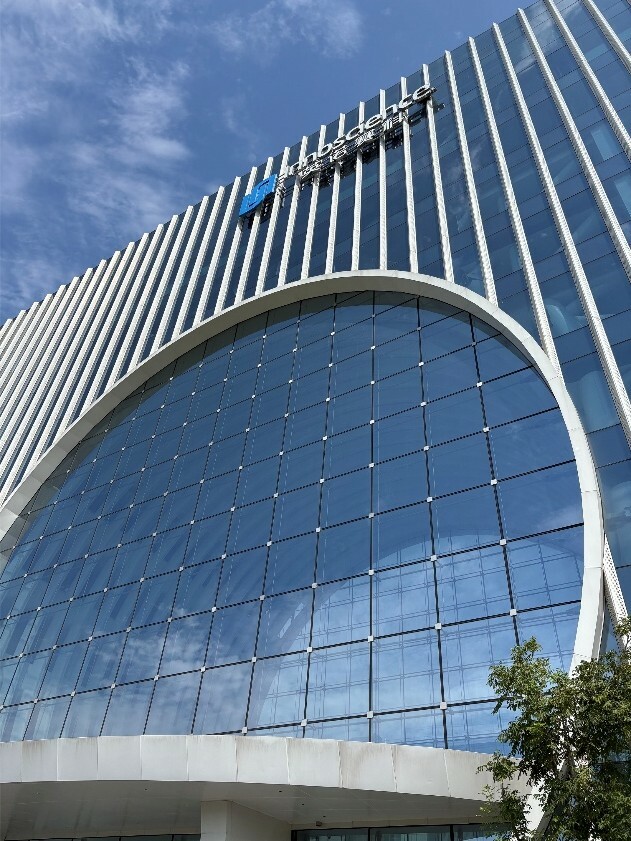 y are making losses. In higher-value glass (head-up displays, panoramic roofs, dimmable glass), Fuyao’s share is higher still, and carmakers prefer to stick with suppliers they know. These categories already make up around 60% of its auto glass revenue, and the share is rising.
Positions like these are rarely won without taking risk, and without investing well before the economics are proven. Innoscience makes gallium nitride (GaN) power chips, which are smaller and more efficient than silicon. It argues they are essential to the 800V power systems that next-generation AI data centres will need. It says it is the only GaN player with both device and wafer manufacturing at scale. It also notes that most of the world’s gallium supply is in China. Capacity is 20,000 wafers a month today, targeted at 30,000 by year-end and 70,000 by end-2027. Management expects every GPU to be GaN-powered by 2030.
AGI, or just general AI?
Access to process technology and tools continues to slow Chinese AI model and infrastructure development relative to the West. This much is likely to remain true, though the gap is stable and best measured in months not years. Crucially, the same is not true of AI adoption. The reverse may even be more likely. Cheaper models, and ‘good-enough’ performance has moved focus on more quickly to business models, products and services that stand to be improved through AI. Naturally while Western economies built on knowledge-based industries like software and financial services wonder at the disruption to the knowledge-based hierarchy from AI, China’s focus – as factory to the world in physical goods – has been on the physical world, and physical AI.
Take smart glasses. Rokid, which is preparing to list in Hong Kong, insists it is an operating system company, not a hardware maker. In the US, the hyperscalers build their own; in China only Huawei has one, and Rokid aims to be the Android of smart glasses: one platform, many brands. Its glasses already run on four Chinese models (Qwen, DeepSeek, Doubao and Zhipu) and connect to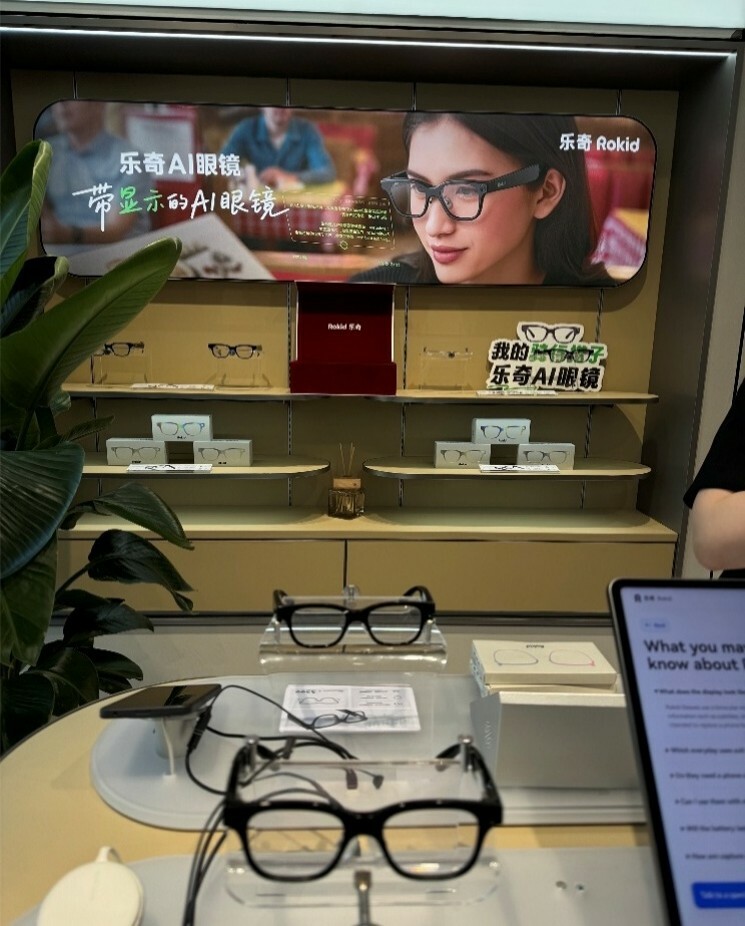 WeChat and Alipay for payments.
The constraint is not the AI but the optics. Lenses make up 30-40% of a pair’s weight, and glasses with an integrated prescription sell for RMB5,000 (frames and lenses). Enter Conant Optical, a Rokid shareholder and research partner, and the world’s second-largest lens maker after Essilor. It charges half Essilor’s price for the same lens, at half the cost, is the designated core lens supplier for Meta’s AR glasses, and is in advanced talks with Apple. The economics are what matter: a traditional lens sells for RMB23, a non-display AI lens for RMB50, and a lens for display glasses for ten times the traditional price. Core revenue grew 10% in the first half and profits 20%, before XR has contributed in earnest.
China’s other advantage is centralised rollout. Some 76% of cars sold in China already carry some form of driver assistance, and Horizon Robotics supplies half the L2 market, twice Mobileye’s share; and regulation will widen the base further with a national mandate for mmWave radar on L2+ cars scheduled for June 2027. Again, however, the rush to be first carries risks for investors. Orbbec, which makes 3D vision sensors, says its structured-light patents make it, alongside Apple, the dominant holder in the field. It claims more than 70% of the service-robot market in China and Korea.
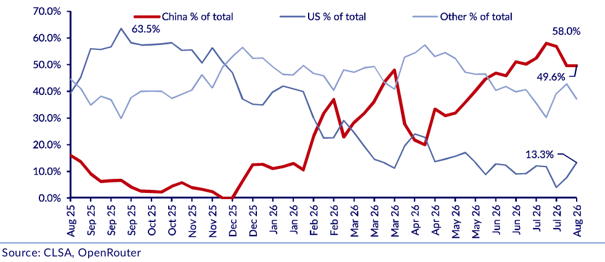
Intel’s RealSense, once its main rival, was spun off after sustained losses and now partners with Orbbec. Robotics revenue rose fivefold in the first half and humanoid revenue tenfold, albeit to tens of millions of renminbi. Yet many products today are sold at cost, or lower. Its data-collection devices are sold as loss leaders to win a place inside tomorrow’s robots. Policy is lending a hand: MIIT and the NDRC have earmarked RMB45bn for embodied intelligence, targeting 50,000 units by 2028, and China already accounts for almost all humanoid shipments (see chart).
China’s commitment to rebalancing its economy, and pursuing profits over volumes remains to be proven. With debt loads and fiscal imbalances in their current state across the West, the question remains how fast – not ‘if’ – the RMB strengthens from here. In this scenario, the imperative to embolden households to spend will be greater than ever. Our funds stand positioned to benefit from these two trends: tech leadership with profits, and the long-awaited consumer recovery.
Company Focus : Bilibili
(Market Capitalization: $6.3bn, Sales: $4.9bn FY26e , P/E: 11.8x FY27e)
Bilibili is China's leading platform for longer-form video, built around a young, highly engaged community now in its mid-20s. That cohort is growing up: getting first jobs, earning more, and becoming more valuable to advertisers. We met Senior IR Emily Guo, and came away with a clear example of AI earning its keep.
The improvement shows up in advertising. Click-through rates rose 90% year on year in the second quarter, and advertising revenue grew 28%. AI now reads context beyond the video itself, such as comments and chats, to match ads more precisely. It also lowers the barrier for advertisers, helping them generate ad content, and the number of advertising clients grew in the mid-teens in the first half. Bilibili places itself among the few platforms gaining ad share, alongside RedNote and Douyin.
Crucially, it shows up in profits, not just volumes. Gross margin reached 37.2% in the second quarter and is still rising towards a medium-term target of 42-45%. Ad load can rise from 7-8% to 10-12%. Users spend around 120 minutes a day on the platform, but 60-70% of that time is in places that carry no ads yet, such as watch pages, search and mini-programmes, which leaves room to grow.
AI capex is about RMB1bn this year, most already spent. Bilibili is not building a foundation model; it has built a video-creation harness that augments creators' work on top of others' models, and it rents cloud capacity, which it secured at good prices last year. Content creation is accelerating, with daily submissions up 28% year on year.
The risks are real. Chips are getting harder to obtain. Games, with three new titles due next year, remain lumpy. But, for investors looking for proof that AI adoption in China can drive earnings, Bilibili is among the clearer answers we heard. Bilibili is held across GemFunds.
Company focus: POCO Holdings
(Market Capitalization: $4.2bn, Sales: $250m, P/E: 36x FY27e)
POCO was one of the surprises of the tour. Its legacy business, alloy soft magnetic powder cores used in power inductors for solar inverters, storage, EVs and air-conditioning, is the global leader with 27% share, roughly double the next player. The growth, and the margin, is in AI chip inductors, which sit beside GPUs and accelerators to regulate power. These earn gross margins of 40-50%. POCO holds about 20% market share, second to Delta's Cyntec at about 60%, and is gaining share. Management guide this product’s growth over the next 2 years at a near triple digit annual rate.
The barrier is know-how. The ingredients are ordinary metals, not rare earths; the edge lies in the powder formulation and the atomisation and co-firing process, which competitors have not replicated. Compared with Delta, POCO says its parts are more compact, which matters as power density inside the rack rises and board space shrinks.
Qualification takes 12-18 months, which protects incumbents. Capacity ramped from June and runs at full pace next year, with a further factory planned for 2028. The main customers sit in the power-module chain feeding AMD, Amazon and Google. At 36x for 30% growth in earnings per share however, Poco’s technical advantages are relatively well-priced.
