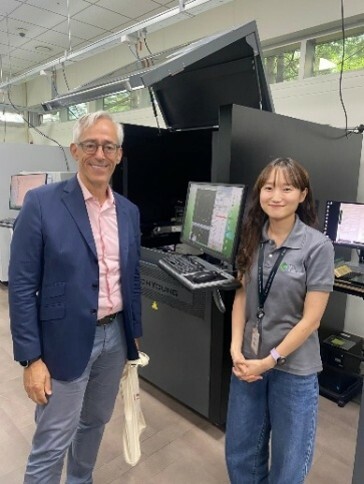
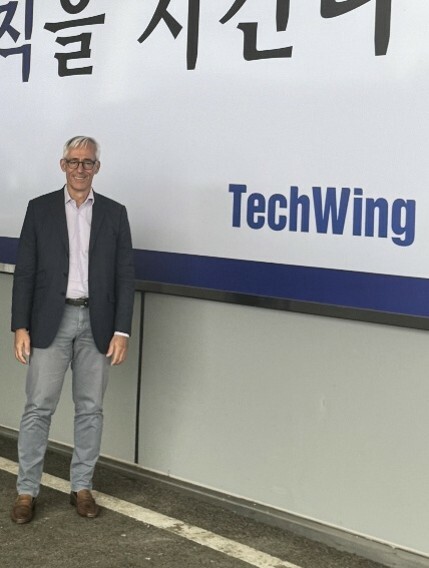
In June 2026, we travelled to Korea for a 7-day trip. We met close to 20 companies, half of them in their respective offices, the rem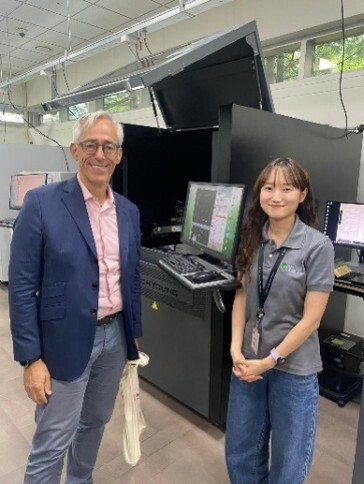 aining half at the CLSA North Asia conference in Seoul, a corporate event that gathered 350 investors with 80 companies, mostly Korean. The conference was very well attended by many international investors. Undoubtedly the interest in Korean names (mostly in technology) was there.
The list of companies we met largely covered the tech sector focusing on semiconductor and automation equipment providers (Techwing, Park Systems, Wonik IPS, AP Systems, Koh Young Technology, SPG Co and EO Technics), electric transformer makers (Hyosung Heavy, Sanil Electric), and industrial companies (Hanwha Corp, Hanwha Solutions, SFA Engineering). We also met 3 Hyundai group companies (Hyundai Motor, Kia Motors, Hyundai Mobis), Samsung Biologics, SK Square (holding company of SK Hynix), and battery maker LG Energy Solutions.
Market focus: the KOSPI index
 Despite the Korean market delivering one of the strongest global performances this year (up 80% by mid-year), foreign investors have been persistent sellers; 90% of these outflows of c$50bn y-t-d have come from SK Hynix and Samsung Electronics. This dynamic mirrors prior episodes in Taiwan and mainland China, where sharp outperformance in certain stocks forced funds to trim positions to avoid excessive single-name concentration.
In contrast, domestic retail investors have emerged as a powerful counterbalance, absorbing all the foreign selling. Sentiment among local investors has remained firm, underpinned by supportive policy signals and strong market momentum. Meanwhile, the use of leverage by local retail investors was also at a new high.
Hence, the powerful 1H26 rally has been abruptly unwound alongside a sharp selloff in global semiconductor stocks. While the correction has been amplified by domestic factors, the broader story is a sharp reassessment of the semiconductor demand outlook and growing concerns over the emergence of new Chinese competitors. Prior to last week of July’s rebound, the KOSPI index had fallen by over 40% from its June peak, marking one of the deepest drawdowns in over two decades – second only to the episode at the onset of the Global Financial Crisis in 2008. Among the reasons for the steep correction, one can mention the following factors:
- Force selling by leveraged ETFs and by the National Pension Fund:
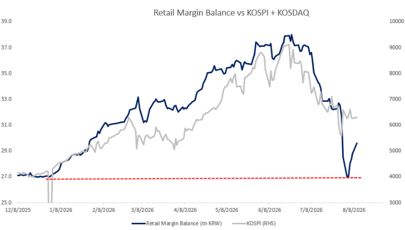
KOSPI margin loan balances have fallen from around KRW27tn at May-end to roughly KRW22tn currently, a drop of over 19%. Post sell-off, we view current margin financing levels as reasonable relative to the overall size of the Korean equity market, rather than a sign of excessive leverage. Will the crackdown on leveraged ETFs trigger systemic risk? Our answer is no, because the leverage situation is far from a systemic proportion to threaten overall financial stability and the banking sector. The latest volatility exposes some longer-term challenges of the Korean market, such as a retail base with a strong speculative appetite and concentrated index composition. However, even at the peak, the AUMs of leveraged ETFs were about KRW40tn ($29bn, 0.5% of the total capitalization of the Korean market, 20% of local equity ETF AUM). Any contagion to the broader financial system should be very limited, as commercial banks have little exposure to investor leverage and broker receivables. There is no systemic risk to overall financial stability.
- Competition from Chinese players such as CXMT.
The most immediate “China factor” in the Korean/global semi selloff has been the listing of CXMT and the fact that China is beginning production of homegrown DUV chipmaking tools. While these breakthroughs are important and may potentially change the competitive landscape of the global tech sector, they should be put in a proper perspective. CXMT is still far smaller and mostly focuses on lower-tier products. It holds 8% of global market share. Meanwhile, its product mix leans heavily toward legacy and mainstream consumer segments rather than the cutting-edge nodes for AI computing. CXMT can only produce HBM at the end of this year and remain at least two generations behind Hynix, Micron, and Samsung. Similarly, Chinese DUV lithography machines are generations behind, and the projected deliveries are negligible compared with the Dutch giant ASML. China has reportedly completed a functional working EUV prototype, but it will take years to be commercially viable.
Furthermore, China is also engaging in the AI “arms race” with the U.S., meaning Chinese chipmakers are facing similar supply capacity constraints, and are far from “flooding the world” with cheap alternatives.
- Sustainability of the AI capex spending by hyper-scalers / AI LLM business models:
So far, US hyper-scalers (Microsoft, Amazon, Alphabet, Meta) have remained committed to their capex guidance for 2026 and 2027. On this point, Alphabet further increased its 2026 guidance by $15bn to $195-205bn in its 2Q26 earnings release. Microsoft and Amazon did the same when announcing their 2Q results. Morgan Stanley projects that hyper-scalers will spend a total of $3.5tn between 2026 and 2028. However, this reassuring news did not stop the decline in semi stocks in July. Investors have also been worried by competition from Chinese frontier models and the rise of open-source AI models (the so-called Kimi K3 moment similar to the DeepSeek moment in January 2025). Rather than reducing infrastructure demand, Chinese competition is more likely to accelerate AI adoption and increase compute demand, which should be positive for memory makers. Financing capex has also been a source of worry. Major hyper-scalers are turning FCF negative while more leveraged players like Oracle see their debt downgraded.
In this environment, the memory supply/demand situation remains hugely favorable for memory makers. 2026 is going to be their best ever year in terms of both sales and profitability. The price of 8Gb DDR5 memory rose by 515%, climbing from $3.90 in July of last year to $24.00 in July of this year. During the same period, the price of 16Gb DDR5 memory surged by 757%, rising from $5.25 to $45.00. Meanwhile, the price of 128Gb NAND flash memory skyrocketed by 786%, jumping from $3.39 in July of last year to $30.05 in July of this year.
Samsung claims the fulfillment rate of memory demand from Big Tech clients currently stands at 60%, and hyper-scalers are increasingly demanding 5-year LTAs rather than 3-year.
Facing this huge demand increase, DRAM makers are increasing capacity but given the complexity of advanced memory manufacturing and their reluctance to flood the market, DRAM makers are increasingly interested in signing Long Term Agreements (LTAs - 3 to 5 years) with their customers (a situation which is also reciprocal as customers are keen to guarantee future supply). Both Samsung and SK Hynix have mentioned that close to 30% of their future capacity are committed through these LTAs. While these LTAs reduce the cyclicality of sales and increase future visibility, price commitments remain unsure. In the meantime, Korean makers are indeed increasing their capex:
Samsung Electronics (Market Cap $950bn) will see its capex going from KRW47tr in 2025 to 70tr in 2026, 2027 and 2028 respectively. As a % of sales, it will go from 14% in 2025 to 10% in 2026 and 7-8% in 2027 and 2028, allowing a healthy FCF generation of close to $750bn in the combined 3 years (2026-2028).
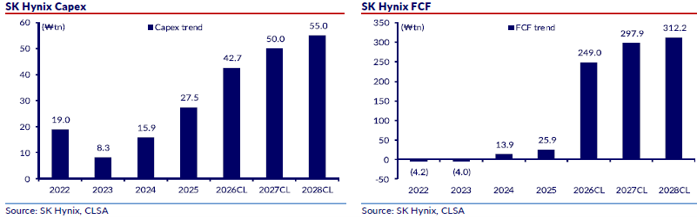
SK Hynix (Market Cap $740bn) will see its capex going from KRW28tr in 2025 to 40-45tr in 2026 and 50-55tr in 2027 and 2028 respectively. As a % of sales, it will go from 28% in 2025 to 13% in 2026 and 10% in 2027 and 2028, allowing an extremely healthy FCF generation of close to $580bn in the combined 3 years (2026-2028).
In conclusion, we believe the sector remains key in the global AI value chain. Memory demand has fundamentally changed. The industry has evolved from a consumer electronics-driven cycle to a data center-driven cycle, and now increasingly to a token-driven cycle in the age of agentic AI. Unlike traditional computing workloads, agentic AI requires larger context windows, persistent memory, and continuous inference. As a result, memory demand no longer depends primarily on device shipments or population growth. Instead, it depends on AI workloads operating around the clock, making memory one of the most critical bottlenecks in the AI value chain.
Both Korean leaders now trade at below 5x 2026 earnings. Despite being committed to capacity increase, they can generate huge FCF and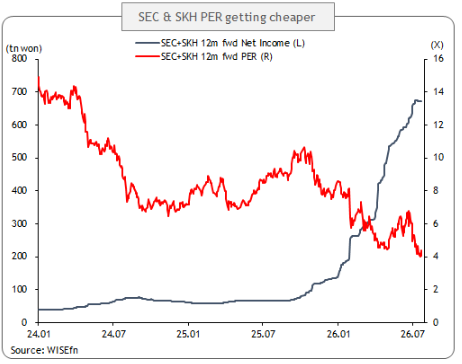 should return a big part to shareholders through higher dividend and share buybacks.
In this environment, memory demand growth should remain significantly stronger than in previous semiconductor cycles. At the same time, supply expansion has become increasingly difficult. Historically, memory manufacturers reduced bit costs through process scaling. Today, further scaling delivers diminishing returns while becoming more technologically challenging and capital intensive. The emergence of HBM has further tightened supply, as larger die sizes consume substantial wafer capacity and limit output growth for conventional memory products. As a result, productivity gains can no longer satisfy demand growth. The industry increasingly relies on nameplate capacity expansion, creating sustained demand for wafer fab equipment. Importantly, memory manufacturers now enjoy much greater demand visibility than in previous cycles. This significantly improves the economics of capacity investment and enables longer-term fab expansion planning. For memory equipment suppliers, this translates into stronger growth visibility and structurally lower cyclicality than the industry has historically experienced. The expected multi-year memory capacity expansion cycle should benefit front-end equipment suppliers with direct leverage to DRAM and NAND capex.
Sector focus: Semiconductor Equipment Manufacturers
We see Korea semiconductor equipment entering a multi-year structural growth phase driven by 2 factors:
- Samsung and SK Hynix plan to invest KRW2.1tn and 1.1tn, respectively over the next 10+ years.
- Korea’s latest semiconductor initiative, announced by President Lee in late June 21026 (The $1tn “Triple Axis” initiative).
Company focus: Wonik IPS (Sales: $1bn - Market Capitalization: $5bn)
 Wonik IPS is a South Korean semiconductor equipment founded in 1991. It develops, manufactures, sells, and installs semiconductors, display, and solar cell systems. The company focused on deposition, etching and encapsulation. Semis made up to 78% of sales, while display 22% of 2025 revenue. The semi proportion is expected to grow to 86% in 2026
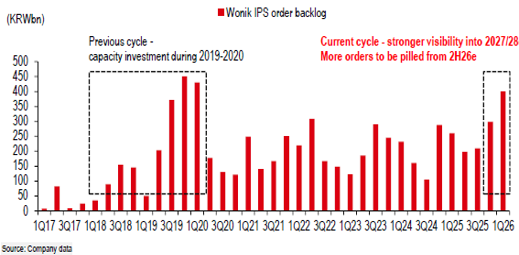 and 90% in 2027. The company is a core partner of Samsung (70-80% of sales), which itself holds roughly a 5% stake in the company. Its growth is geared to semiconductor technology migration and long-term fab expansion by major Korean semiconductor chipmakers. Thanks to its high exposure to Samsung Electronics, the firm is the best beneficiary from the capex upcycle represented by Samsung P5/P6 and more fabs in Yongin semi cluster in Korea. Its order book (see graph) has started to accelerate in 4Q25.
Consequently, its sales and profit have been revised up over the last 12 months (+66% for EPS). Over a 3-year period (2026-2028), we expect the company sales to double from its level in 2025. EPS is expected to rise 50% pa on the same period. The stock trades at a 2026 PER of 24x.
Bruno Vanier
President - Gemway Assets