In early 2000, Infosys Technologies, a relatively young company that manufactured nothing physical and owned little more than campus real estate and computers, saw its market capitalization surge to an astronomical ₹59,338 crore (roughly $13.6 billion at the time).
To the bewilderment of traditional industrialists, this meant a software services exporter was suddenly worth more than India’s historic manufacturing backbone, more than Tata Steel (TISCO), Steel Authority of India (SAIL), and Larsen & Toubro (L&T) combined. A popular narrative emerged: India had successfully "bypassed" the industrial revolution. Fast forward to today and the contrast is stark. Simply put, the industrial ‘old’ economy might be bailing out slowing revenue growth in IT services following the arrival of AI. Such was the backdrop for 14 meetings over a handful days, at our offices in Paris, and the India conference in London of a local broker, Kotak Securities.
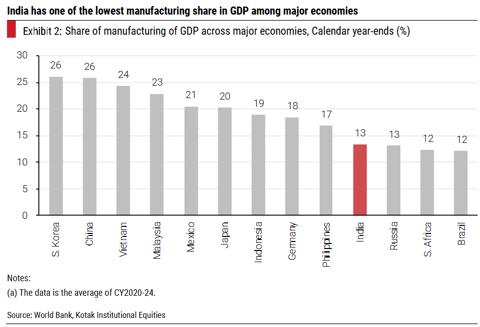
India’s energy dependency has always been its Achilles’ heel: high oil product prices tend to slow activity across the economy or blow a hole in the budget as the government intervenes to protect consumers, and farmers in particular. An irony of the claims to have ‘bypassed’ the industrial revolution is that agricultural labour was never transferred from field to factory, leaving India’s agricultural share of GDP still at very high levels, and looking decidedly anachronistic.
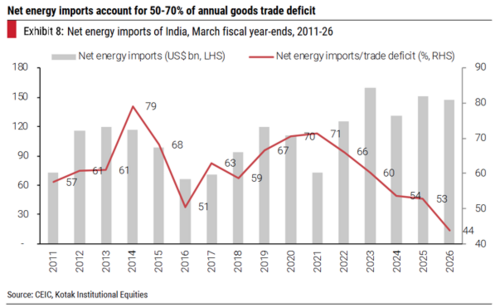
In FYE 03/2014, Indian energy imports hit a peak, equating to 79% of the overall trade deficit. Since then that percentage has been steadily falling, reaching 44% more recently. Policy has helped at the margin (rising domestic production, such as renewables), but the real tailwind has been falling oil prices and a large discount on crude it buys from Russia.
This year all that changed, and dramatically so. India’s effective cost of imported oil increased more than most other energy-dependent nations due to the closure of the straits of Hormuz and the Russia discount closing. Having dropped diesel excise duties to zero, India was faced with no other choice than to pass on 8 rupees in fuel price increases to consumers. This may not seem a lot, but it is more than prior oil cycles.
India can be rightly proud that PMIs remain healthy even after this upheaval. Official forecast GDP growth stands at a stillrobust 6-6.5% for this fiscal year, though local brokers warn this may be optimistic. The corporate mood in aggregate remains upbeat, reflected in high teens year-over-year growth for credit across the corporate sector. Raising fuel prices and seeing them absorbed in an orderly way is definitively a good thing. Our meetings offered the chance for some relevant channel checks here. Shriram Finance (2.3% of GemEquity), a non-bank lender against two- and four-wheeler vehicles talked of robust asset quality despite the shock. It will grow its book nearer to 15% rather than 18% trend until fuel restrictions are totally removed, but this is far from signalling a downturn. Meanwhile, for GMR Airports jet fuel price pressure has compounded already reduced demand for air travel, but a far bigger factor has been the short supply of planes and pilots, and these bottlenecks are easing. Across the variety of industrial firms we interviewed, complex chemical manufacturers, synthetic textile makers, and pharmaceutical firms none complained of any serious disruption to supply, or lasting damage to demand.
The stock market is not the economy
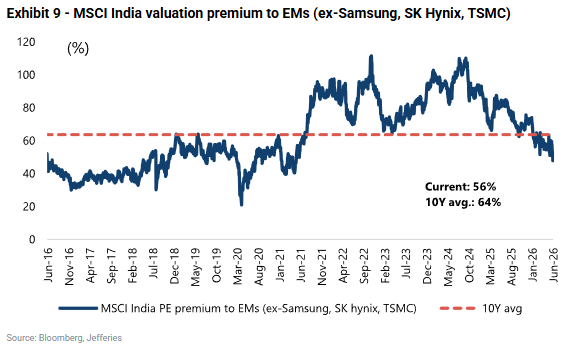
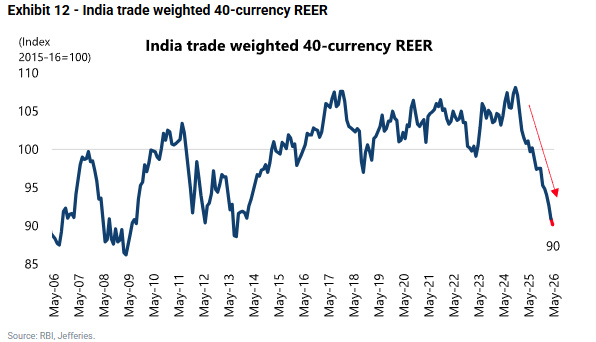
While India’s significance in Emerging and Asian indices has been falling due to a weak currency and the outperformance of Taiwan and Korea, beneath the surface the change in breadth and sector composition is notable. SEBI reports 315 cumulative new mainboard listings across the last 5 years. IT’s weight has dropped nearly 8bpts to 6.5% of MSCI India, while Industrials and Utilities have doubled in aggregate weight to more than 15%. Combined with Materials – a further 9% of the index – active investors have a broader choice than ever to select stocks that will help pick up any slack from IT services. While these firms may not generate the same export dollars directly, their impact on India’s trade account is similarly useful, as they directly substitute US dollar-priced imports.
Examples of this import substitution trend include specialty chemicals firm Aether Industries which calculates India’s chemicals trade deficit at more than $30bn and is systematically targeting opportunities here. Their success here showcases the virtuous cycle of investing in an export economy in action: having begun by targeting import substitution, they have reinvested in proprietary knowhow, grown their R&D engineer base, and graduated to become the first-ever non-US outsourcing partner of Milliken, a storied American chemicals conglomerate, a contract set to generate INR2bn for the company in the 2028 financial year, an increase of 17% on the revenue base of the year just published. In defence, Paras Defence & Space Technologies has been growing its portfolio of specialist optics products for use in submarine periscopes, defensive laser systems, as well as in space. Here, national security is driving enormous economic opportunity for Paras which has been investing in optics capabilities for fifteen years, of which 5 were spent in qualification for usage of their products in space. Meanwhile, fears about businesses like Infosys and Tata Consultancy Services need to be separated from strong ongoing growth in India’s global capability centre (‘GCC’) economy. Employing 1.8m people – nearly a third of the size of the IT services sector – hiring is still growing at a mid-teens pace per Infoedge, owner of jobs classifieds platform Naukri, while Lodha Developers referenced the strong demand for premium residential housing from this corner of the economy. CEO Abhishek Lodha – son of founder Mangal Prabhat Lodha – also spoke of the conflict in Iran spurring non-resident Indians to retain a residential base in the country, which has been supporting the housing segment’s sales, even as the company works to develop new recurring revenue streams in industrial real estate including data center power shell construction for global MNCs and hyper-scalers.
Liquidity versus the economy
The Reserve Bank of India has had non-resident Indians also on its mind. While the wave of new listings has broadened the Indian market, it has enabled many foreign strategic investors to effectively reduce their capital investment in India. This is reflected in the national capital account as a negative move in foreign direct investment (FDI). For many years, regular FDI underpinned the country’s external balances, reducing any pressure on the currency from the trade account. Again, this pattern has changed: from $30-$40bn p.a. across 2019 to 2024, the print for the last two financial years was below $10bn. Ongoing gold purchases by India’s middle class worsens this dynamic, effectively removing cash from the economy. The RBI’s innovative response has been to offer to cover the cost of hedging for non-resident Indians investing cash in fixed term deposits in India, converting net returns to Indians based abroad from funds invested domestically to nearer 6% p.a. from 3-4% before. This measure is expected to deliver more than $50bn to the economy in the coming months.
Industrial revolution revisited
So, having apparently survived the oil shock, sustained outflows by portfolio investors to more tech-centric equity markets, and divestment by strategic investors, can we say that India’s outlook is now more straightforward? Sadly, there is one weather-related spectre looming. Monsoon rain forecasts for this year’s predicted strong El Nino event point to a tough time for the food sector, which has historically spelt higher inflation. This should only add to the strategic clarity: the economy must continue to evolve, to improve skills accumulation and to double down on its gains in export manufacturing. This will require technology partnership with foreign firms, which may cap the pace of pure import substitution less technological partners feel they are losing out. All in, sustained inflation amidst healthy economic growth points to rates remaining elevated which should support the funds’ holdings in financials such as Shriram Finance, ICICI Bank and HDFC Bank, while further efforts to drive the export sector augur well for recent additions to the funds such as Dixon Technology.
Company Focus: Acutaas Chemicals (Market Capitalization: $2.8bn, Sales: $152M, P/E: 57x)
 Acutaas is a Surat-based Indian specialty and fine chemicals manufacturer, listed on the NSE in 2021. Founded in 2004 supplying a single active pharmaceutical ingredient to a European innovator, the company has since rebuilt itself around high-value, IP-protected chemistry, deliberately phasing out low-margin commodity lines and reinvesting capacity into advanced pharma intermediates, CDMO, battery electrolyte additives and semiconductor chemicals, improving margins in the process. Acutaas sits squarely within the structural opportunity now being championed at the policy level, that is India's drive to substitute imported specialty and electronic-grade chemicals, where the country runs a chemicals trade deficit of over $30bn and remains heavily dependent on China.
The business runs on three engines. The first and largest is advanced pharma, contributing the bulk of last year's ₹1,340cr ($139m) of revenue, and split roughly evenly between CDMO and non-CDMO. The CDMO franchise is anchored by Fermion of Finland, for whom Acutaas supplies darolutamide — the API in Orion/Bayer's prostate-cancer drug Nubeqa — at ~75% wallet share, with volume guidance secured four years out and a US patent cliff not until 2033. Two further indications read out in 2027 and 2028, potentially tripling the addressable patient population. The non-CDMO arm holds its own IP across ~400 products, focused deliberately on chronic, daily dosing molecules, selling to both innovators (Novartis, Boehringer Ingelheim, Sanofi) and generics players (Teva, Divis, Laurus). A newly built facility at Ankleshwar (440kl versus the legacy 140kl) gives a long runway: four new products are validated and ~99% derisked, expected to add ~₹300cr ($31m) of revenue by March 2029.
The second engine is battery electrolyte additives (VC and FEC), Acutaas's first facility outside China for these anode-protecting molecules, supplying Korean customers on an export-only basis at a $55m three-year run-rate and 15-20% EBITDA margins. China holds ~74% of global supply and the market is in oversupply, but pricing has improved (from $10-20/kg), VC is under genuine supply constraint, and raw materials are almost entirely India-sourced — a position now further helped by China's withdrawal of export rebates across the lithium-battery supply chain. The third and least proven engine is semiconductors, via a Noida-based arm (Baba, 55% stake) and a 75%-owned photoresist JV in South Korea (Indichem), supplying photolithography inputs to clients including Sumitomo and SK Chems; at ~₹200cr ($21m) capex and a 4-year ramp, revenue is not expected until end-2031.
Company Focus: PB Fintech (Market Capitalization: ~$8bn, Revenues: $770m)
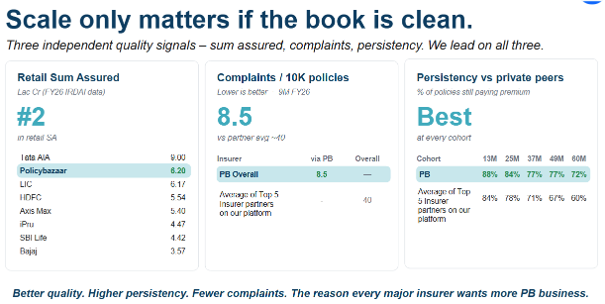 PB Fintech operates Policybazaar, India's largest digital insurance marketplace, alongside Paisabazaar in lending. Listed on the NSE and BSE in November 2021, the company has built a dominant position in the online distribution of insurance in a structurally underpenetrated market. India's insurance distribution is shifting steadily online from agent-sold channels, and Policybazaar today represents roughly 70% of the digital channel for insurance sales in the country — a share that edges higher each year, with the balance held by insurers' captive digital arms. Health insurance, the company's fastest-growing line, has grown over 60% year-on-year for sixteen consecutive quarters, with ~82% of health customers fresh to the market, and two-thirds of the health base under 35. We met founderCEO Yashish Dahiya and co-founder Alok Bansal, and were struck by the consistency of the strategic narrative — every adjacent initiative aims to strengthen a single core skill: managing the insurance back end and claims process better than anyone else.
Management describes claims handling — not distribution — as PB’s durable edge: as an aggregator, PB uses its market position to push insurers to honour policies and runs an annual "claims settlement day" re-submitting previously rejected claims, on which it reports passing ~70% of cases. The quality and consistency of its data (customers who chose to buy, rather than were sold) is a second source of value to insurer partners. The risks are equally clear and management was candid about them. The principal overhang is regulatory: a recurring fear that each incoming IRDAI chair targets Policybazaar for excessive channel power, most acutely around a potential commission cap. The take-rate is paid out of insurers' capped expense budgets (30% general / 35% health), so there is structural pressure on digital-channel payouts as insurers optimise within those limits. A second tension is partner conflict: standalone health insurers (Niva Bupa, Star Health) drive marketplace traffic even as PB Health builds competing hospital and preventive-care capacity. PB offers a differentiated exposure to the formalisation of Indian insurance distribution through the one platform with genuine scale and a strategy to tackle India’s broad insurance gap head-on.
Supporting data slides, for reference
William Scholes - Senior Fund Manager