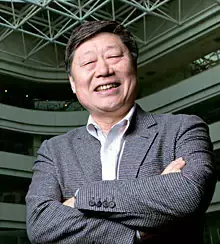
At 76, Zhang Ruimin is a Chinese entrepreneur, founder and honorary chairman of Haier Group, one of the world’s leading home appliance manufacturers and China’s leader in connected devices. (His net worth is estimated at $1.3bn, source: Forbes, January 2026)
 Zhang Zhang Ruimin was born on January 5, 1949, in Laizhou, Shandong province, in northeastern China, during a period of national reconstruction. He came from modest beginnings and started his professional life as a factory worker on a production line, an experience that gave him a concrete and lasting understanding of industrial work, manufacturing constraints, and on-the-ground realities.
In December 1984, the municipal authorities of Qingdao appointed him to lead the city’s refrigerator factory, Qingdao Refrigerator Factory, a struggling collective enterprise on the brink of bankruptcy, producing low-quality goods. Zhang initiated a radical transformation. The period from 1985 to 1987 marked a quality revolution. A licensing agreement with Germany’s Liebherr enabled the import of technology and industrial standards. In a symbolic gesture, he destroyed 76 defective refrigerators to signal a break from a volume-driven culture in favor of quality. Between 1987 and 1989, Zhang imposed a new managerial discipline: individual accountability, incentive systems, and performance evaluation gradually replaced the administrative logic inherited from the planned economy. From 1989 to 1991, the company began its strategic transformation. Production shifted from state quotas to real market demand. Haier progressively built its brand through targeted marketing investments and began diversifying into other home appliances, such as air conditioners and washing machines. These transformations laid the groundwork for the official creation of Qingdao Haier Group in 1991.
Haier’s IPO on the Shanghai Stock Exchange in 1993 marked a major strategic turning point. The offering raised RMB 370 million, financing the construction of the Haier Industrial Park in 1995 and expanding production capacity. More importantly, it introduced an unprecedented level of governance discipline and transparency, strengthening Haier’s credibility with international partners. For China’s industrial ecosystem, the IPO demonstrated that a state-owned enterprise could become a global player, inspiring others to modernize their ownership and management structures. Zhang applied a simple but rigorous method: immediate diffusion of a quality culture, individual accountability, and intensive training in performance standards. Rather than shutting down struggling businesses, he showed that radical managerial change could be sufficient to turn them around. This approach, absorb, transform, integrate, made him a pioneer of industrial consolidation in China and inspired other leaders to view distressed companies not as failures to liquidate, but as assets to be revitalized through corporate culture.
In 1999, Zhang invested $30 million to build a production facility in South Carolina—a bold move for a Chinese brand at the time, driven by the conviction that conquering the U.S. market required local production. Haier initially targeted niches overlooked by major brands (mini refrigerators, electric wine coolers). The strategy proved successful: by the early 2000s, Haier held up to 60% of the U.S. electric wine cooler market. In 2005, group revenues exceeded $12 billion, and the Financial Times ranked Zhang among the 50 most respected business leaders in the world.
A series of major acquisitions followed. In 2011, Haier acquired Sanyo Electric’s washing machine and consumer refrigerator businesses in Japan and Southeast Asia. In 2012, it acquired New Zealand’s Fisher & Paykel ($766 million), a premium brand in Australasia. In 2016, it completed its most significant deal: the $5.4 billion acquisition of General Electric’s appliance division, making Haier the owner of one of the most iconic industrial brands in the United States. In 2019, it acquired Italy’s Candy Hoover for €475 million. In less than a decade, Haier built a global portfolio of brands spanning all market segments, from entry-level to premium.
Alongside this expansion, Zhang Ruimin developed, starting in 2005, a management model that would define his global reputation: RenDanHeYi. The principle is radical, eliminate middle management layers and organize the company into autonomous micro-enterprises directly connected to user needs. Each employee is treated as an entrepreneur responsible for the value they create. The model has been presented at Harvard, Wharton, and the World Economic Forum. In 2023, Zhang received the Thinkers50 Lifetime Achievement Award (often described as the “Oscars of management thinking”), becoming the only Chinese entrepreneur to receive this distinction. He is described by colleagues as a demanding leader, disinclined toward personal publicity, whose authority stems more from the coherence of his thinking than from his title. His philosophy has influenced management scholars worldwide.
Zhang Ruimin stepped down from operational leadership in 2021 after thirtyseven years at the helm of Haier. He continues to serve as Chairman Emeritus, dedicating his efforts to promoting the RenDanHeYi model among European and global companies. In 2025, he traveled across Italy and San Marino to lead organizational transformation workshops with local business leaders.
Zhang Ruimin is married and resides in Qingdao, the birthplace of Haier.
In a few figures:
- Headquarters: London, United Kingdom
- Founded in 1984
- 2024 revenue: $57bn
- Market capitalization: $130m
- 130,000+ employees
- Presence: 160+ countries, 173 manufacturing facilities and 10 R&D centers
Household appliance in China:
- China accounts for 60–70% of global home appliance manufacturing capacity. In 2024, the Chinese market reached a record with RMB 907bn in sales (+6.4%) and $112bn in exports (+14%). Haier holds around 14% of the global white goods market.
« Leaders must become gardeners of entrepreneurs, not commanders of employees »