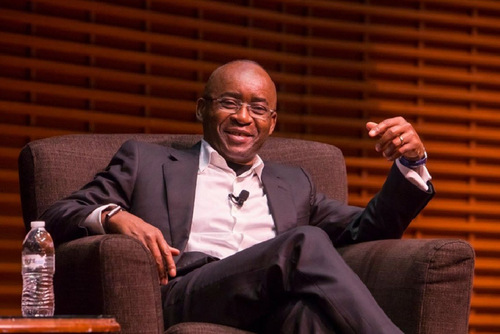
At 64, Strive Masiyiwa is a Zimbabwean entrepreneur, founder and chairman of Econet Group, one of Africa’s leading telecommunications and digital infrastructure companies. His fortune is estimated at $1.3bn (April 2026).
Strive Masiyiwa was born on January 29, 1961, in Southern Rhodesia, into a modest family. His father worked in the mines and his mother ran a small business. In 1968, the family fled political instability and settled in Kitwe, Zambia. Strive completed his primary education there before being sent to Scotland at  the age of twelve for secondary school. In 1983, he earned a degree in electrical engineering from Cardiff University, then briefly worked in IT in Cambridge before returning to Zimbabwe in 1984, as the country had just gained independence.
He joined the Zimbabwe Posts and Telecommunications Corporation (PTC) as a senior engineer, where he witnessed the shortcomings of a state-run system: obtaining a telephone line could take more than ten years, and 75% of Zimbabweans had never heard a phone ring. In 1986, with $75 borrowed capital, he founded Retrofit Engineering, an electrical installation company that grew rapidly during the construction boom. In 1990, he became Zimbabwe’s youngest “Businessman of the Year.” In 1993, convinced of the potential of mobile telephony after observing the rollout of early GSM networks in South Africa, he proposed a majority state-owned joint venture to PTC. The response was categorical: mobile was deemed a “passing fad.” He then founded Econet Wireless and applied for an independent license, which was rejected by Robert Mugabe’s government. Refusing to engage in corruption, he launched an unprecedented legal battle. For five years, he challenged the state in every court in the country. In December 1995, the Constitutional Court struck down the public monopoly, recognizing that access to telephony was linked to freedom of expression. After further political obstruction and economic retaliation that nearly ruined him, the Supreme Court finally ruled in his favor in December 1997. The victory became a continental symbol: an African entrepreneur could prevail over the state through the rule of law.
On July 10, 1998, Econet launched its network in Harare. The success was immediate: within six months, the service covered all major cities, and Econet overtook the state-owned operator, which had launched two years earlier with technical support from Detecon, a subsidiary of Deutsche Telekom. Only three months after launch, in September 1998, Econet went public on the Zimbabwe Stock Exchange. The IPO was oversubscribed and became the fastest in the history of the ZSE.
This listing went beyond raising capital. It sent a powerful signal across the continent: an African technology company could raise funds locally and finance innovation. Econet became a model of local shareholding and confidence in African entrepreneurship. Expansion followed: Botswana, Nigeria (now Airtel Nigeria), Lesotho, Kenya, and later New Zealand. Within a decade, the group operated in more than fifteen countries. The journey was marked by further trials. In 2000, amid Zimbabwe’s deteriorating political climate, Masiyiwa went into exile in South Africa, later relocating to London in 2010. He navigated hyperinflation, currency instability, and constant regulatory pressure.
As early as 2003, he anticipated the strategic importance of fiber optics and launched Liquid Telecom, now Africa’s largest independent fiber network, with over 100,000 km of cable across twelve countries, following cumulative investments of $1.5 billion. In parallel, he developed Africa Data Centres and Sasai Fintech. In 2021, these businesses were consolidated under Cassava Technologies. In 2024, Cassava raised $310 million from Google, the U.S. DFC, and Finnfund. In 2025, a $720 million investment partnership with Nvidia to build five AI factories in Africa marked a new milestone: 15,000 GPUs will enable artificial intelligence models to be trained on the continent without exporting data. In 2025, Time magazine named him among the 100 most influential people in AI. Masiyiwa leads with uncompromising ethics rooted in his Christian faith. He serves on the boards of Netflix, Unilever, and the National Geographic Society.
With his wife Tsitsi, he co-founded the Higherlife Foundation in 1996, which has funded more than 350,000 scholarships across Africa. Called upon by the African Union during the Ebola and Covid-19 crises, he coordinated medical supply efforts for the continent. During the 2019 cholera outbreak in Zimbabwe, the couple committed $70 million. A co-founder of AGRA, a signatory of the Giving Pledge, he received the David Rockefeller Bridging Leadership Award in 2025.
Strive Masiyiwa lives with Tsitsi and their six children in Surrey, England. Their eldest daughter, Elizabeth, joined the boards of Econet and EcoCash in 2025, ensuring the family continuity of a group that has become one of the pillars of Africa’s digital infrastructure.
In a few figures:
- Headquartered in London, United Kingdom
- Founded in 1993
- 2025 Revenue: $ 845M, +23% compared to 2024
- Market Capitalization: $ 130M
- Presence: 40+ countries across 4 continents
- Fiber optic network: 100,000+ km (Africa’s largest independent network)
Telecom sector in Africa:
$220bn contribution to African GDP in 2024, representing 7.7% annual growth 416M mobile internet users 75% of the population still unconnected.
« Integrity is better capital than money. You can accumulate it just like money, and you can use it just like money, but it goes further, and is enduring. »