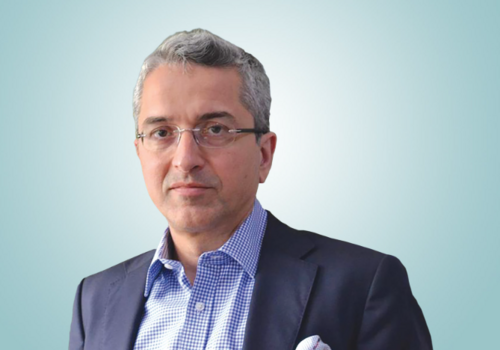
At 56, Sunil Vachani is an Indian entrepreneur and the founder and Executive Chairman of Dixon Technologies, India’s largest contract manufacturer of consumer electronics.
His fortune is estimated at $2.3bn (source: Forbes, April 2026).
Sunil Vachani grew up in an industrial family: his father founded Weston, a pioneer of color television in India. The arrival of foreign brands in the 1990s weakened that legacy. Educated in London, he returned to India in 1992 and, after a stint in the family business, formed a conviction: the future did not lie in owning a brand, but in manufacturing for others. The EMS (Electronics Manufacturing Services) model was virtually nonexistent in India at the time, and few believed that a major global brand would entrust its production to a local subcontractor.
In December 1993, his father lent him INR2Mn and gave him four things: seed capital, the Dixon name, a trusted lieutenant in Atul Lall (future CEO), and his blessing. Vachani rented a small workshop in Noida, hired a handful of employees, and secured his first contract: assembling 2,000 television sets for Goldstar, the Korean brand that would later become LG Electronics. Dixon was born.

The early years were difficult. The EMS model, outsourcing assembly and industrial management to a third party, was still unfamiliar in India, where brands manufactured in-house or relied on imports. Local banks refused to finance a company without tangible assets, despite its high working capital needs. Dixon eventually secured a loan from a Japanese bank more accustomed to financing export-oriented industrial businesses. The company began assembling 14-inch CRT televisions, consoles, VCRs, and telephones. Every contract was treated as a showcase. Dixon quickly understood that its only real differentiation would be execution: meeting deadlines, maintaining consistent quality, and enforcing operational discipline.
In the 2000s, a government contract to manufacture television sets validated the model at scale. In 2007, Vachani invested in LCD lines, anticipating the decline of CRT technology, and three years later shifted to LED, without waiting for the domestic market to force the transition. At every stage, Dixon upgraded its tools and capabilities, staying ahead of the product cycle.
In 2010, Vachani created two subsidiaries: one to manufacture semi-automatic washing machines for Godrej, Samsung, and Panasonic; the other to produce metal and plastic components. He thus initiated a strategy of vertical integration aimed at protecting margins and reducing supplier dependence. Two years earlier, he had already entered the lighting segment, producing CFL lamps for Philips, Havells, and Syska. By 2014, Dixon had crossed a first significant revenue milestone. His method remained constant: no venture capital, no spectacular announcements, but systematic reinvestment of profits into new industrial capacity, at a time when India was focused primarily on services and technology while he was quietly building a manufacturing champion.
The first major turning point came in 2016, when Vachani entered smartphone manufacturing, a segment dominated by Chinese assemblers. The move was risky: thin margins, high technical standards, and strong Chinese technological leadership. He anticipated two favorable trends: the Indian government’s PLI subsidy program and the growing willingness of global brands to diversify production away from China. He created Padget Electronics, a subsidiary dedicated to smartphones, which successively secured contracts with Motorola, Nokia (via HMD Global), Xiaomi, Samsung, Realme, and Oppo. Revenue from the mobile segment rose from $214 million in Q1 2024 to over $1.1 billion in Q2 2025, illustrating a dramatic change in scale.
Dixon went public on the NSE and BSE in September 2017, raising approximately INR600Mn. For India, the IPO sent a strong signal: a contract manufacturer, in a sector long viewed as low-margin and unglamorous, could access public markets and attract institutional investors. Dixon evolved from a regional assembler into a key player in the global electronics supply chain.
International recognition came at the end of 2024 when Padget Electronics, in partnership with Taiwan’s Compal, began producing Google Pixel smartphones for India, the United States, and Europe. Google’s choice, given its demanding manufacturing standards, represented a major validation for Dixon. In December 2024, the company also announced a joint venture with Vivo to manufacture electronic devices in India.
Vachani’s strategy can be summed up in two words: discipline and diversification. No dominant client, no single product, but a gradual move toward design and integration. Dixon is no longer just an assembler; it is an industrial partner.
On a personal level, Vachani is known for a quiet, team-oriented leadership style. When receiving an award from NDTV, he publicly stated: “This recognition belongs to the teams at Dixon, I accept it on their behalf.”
He co-founded the Dixon Applied Technology Training Institute to upgrade the technical skills of employees and young local talent, convinced that India can only become a manufacturing power by training its own technicians. In terms of social responsibility, Dixon runs programs focused on education, renewable energy, and water management in communities surrounding its plants—efforts recognized by EY, which named him a finalist for its Entrepreneur of the Year 2025 award.
Discreet about his personal life, Sunil Vachani lives in New Delhi with his wife and two children.
In a few figures :
-
Headquartered in Noida, Uttar Pradesh, India
-
Founded in 1993
-
2025 Revenue: $ 4.7bn, +120% compared to 2024
-
Market Capitalization: $ 8.1bn
-
23 manufacturing plants in India and 3 R&D centers in India and China
+20,000 employees
Electronics in India :
In 10 years, the country’s electronics production has grown from around $48bn in 2017 to $100bn. In 2025, exports surpassed $50bn, driven largely by smartphones, whose production now reaches nearly $50bn per year. The government aims to build a $300 bn electronics ecosystem by 2026, and $500 bn by 2030.
"It is a golden moment for electronics manufacturing. At last, India is the place to be."